REVIEW · SDE BOKER
Sunset time Ramon Crater Jeep tour, bonfire and stargazing
Book on Viator →Operated by Eyal Korin-Ramon crater tours · Bookable on Viator
Sunset in the crater feels like a time machine. This Ramon Crater tour is built for the cool hours, with a 4×4 drive, viewpoints, a bonfire, and guided stargazing that stays simple and fun.
I like two things most: the private jeep route that crosses the crater on an off-road track, and the way the night sky lesson uses binoculars instead of complicated gear. The one thing to keep in mind is the weather requirement since the experience runs only if conditions cooperate.
In This Review
- Key highlights (quick read)
- Sunset Jeep Into Ramon Crater: How the Night Starts Before It Gets Dark
- Price and group value: $522 per group up to 8
- When and where to meet in Mitzpe Ramon
- Stop 1: Ramon Crater on the off-road route (and what you’ll actually notice)
- Stop 2: Mt. Gewanim lookout for a 360-degree golden hour
- Stop 3: Campfire, tea and coffee, then stargazing with binoculars
- The guide factor: Eyal’s style and why it matters in the dark
- Getting the most out of a sunset crater + stars night
- Logistics, weather, and timing: the only real weak spot
- Who should book this tour (and who should look elsewhere)
- Should you book? My honest take
- FAQ
- When do I meet for the sunset Ramon Crater jeep tour?
- Is this a private tour?
- How long is the tour?
- Do you use telescopes for stargazing?
- What drinks are included at the campfire?
- Is alcohol included?
- Is food included?
- What happens if weather is poor?
- What is the cancellation policy?
- Can children join the tour?
Key highlights (quick read)
- Private group format: it’s just your group on the jeep.
- Golden-hour timing: you ride, stop, and take photos as light changes.
- Off-road crater crossing: leaving the paved road for a 4×4 route side to side.
- Stargazing without telescopes: binoculars, a laser pointer, and clear explanations.
- Bonfire + desert drinks: tea and coffee while you ease into the dark.
Sunset Jeep Into Ramon Crater: How the Night Starts Before It Gets Dark
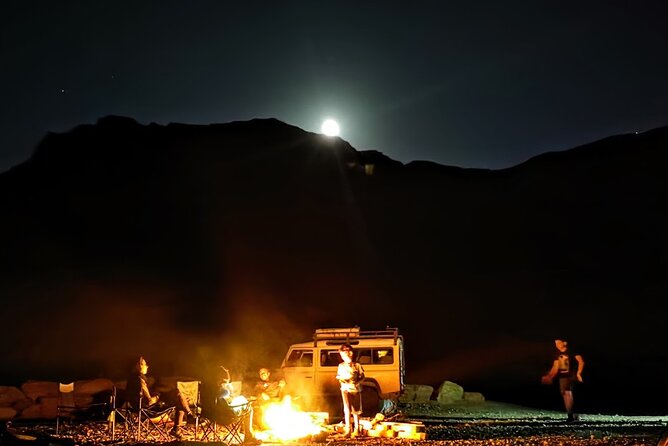
This is one of those desert outings that makes sense the moment you hear the timing. You start roughly an hour and a half before sunset, while the heat is dropping and the sky is doing that shifting, orange-to-purple thing that’s hard to get indoors. Then you keep going through twilight and into night—so you get not just one view, but several versions of the same place.
The tour is private, run by local guides connected to Ramon Crater tours (the company behind it is led by Eyal Korin-Ramon). In a short trip like this, that private setup matters. It means you can move at a pace that fits your group, take photos without feeling rushed, and ask questions without the pressure of matching everyone else’s schedule.
One small reality check: the program depends on good weather. The operator notes that for summer the departures are adapted, and for autumn or winter the reserve window is more limited. You’ll also get a clearer answer about whether it can run only a few days ahead, so treat this like a plan you want to protect, not something to schedule after a packed day with no flexibility.
You can also read our reviews of more tours and experiences in Sde Boker.
Price and group value: $522 per group up to 8
The price is $522 per group with room for up to 8 people. That sounds high if you think per person. But desert tours often run like this because you’re paying for a private vehicle, a guide, and access to the right timing—not just a ride.
Think about value in practical terms:
- If you’re traveling as a small family or a group of friends, you’re buying the convenience of a private 4×4 route plus a guided night-sky experience.
- You’re also getting admission included for the first two crater segments, and tea/coffee included at the bonfire.
- The whole arc—from late-day crater exploring to night-sky explanations—has one job: help you see Ramon Crater at the times when it looks most dramatic.
If you’re traveling solo, the math may feel less friendly. In that case, you might compare it to other Ramon Crater options that don’t require a private minimum. But for groups, the format is exactly what you want out here: comfortable, guided, and paced.
When and where to meet in Mitzpe Ramon
This is a hotel pickup and drop-off experience, but only in the Mitzpe Ramon area. Meeting is typically around 17:30 to 18:00 in Mitzpe Ramon, and you can either meet near town or be picked up from your hotel within that area.
It’s scheduled for a window that runs in the evening (the stated operation window includes Mondays from 5:30 PM to 10:00 PM). Since the tour starts before sunset and continues into darkness, plan for a start time that feels slightly late for dinner plans and perfect for dessert plans that happen later.
Bring layers. Desert evenings cool fast once the sun drops, and you’re going to be outside at twilight and after.
Stop 1: Ramon Crater on the off-road route (and what you’ll actually notice)
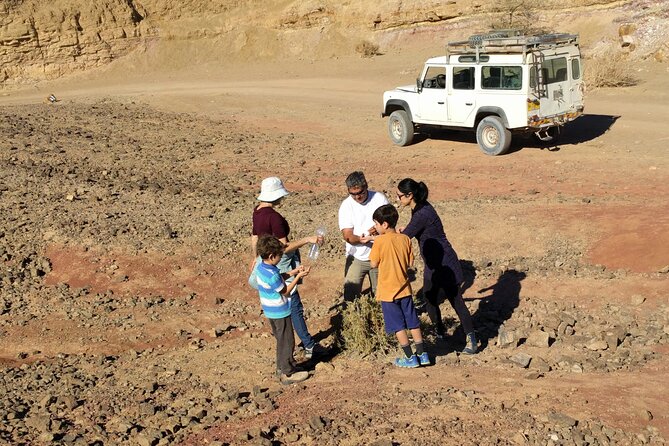
The first stretch is about 1 hour 30 minutes, and it includes admission. You’ll start in daylight and keep the experience moving with multiple stops where you can step out of the vehicle and explore.
Here’s what makes this portion worth your attention: it’s not only about the big views. You’re meant to notice small, desert-specific details—plants and vegetation, plus the colorful rocks, minerals, and fossils you can spot up close. That shift from scenery to details is huge. It turns a drive into a real understanding of what you’re looking at.
Possible drawback: this part is active. You’ll be getting in and out of a 4×4, walking short distances on uneven desert ground, and paying attention while the light changes. If you’re hoping for a purely seated, minimal-walking option, you might find the stop-and-look rhythm a bit much.
Stop 2: Mt. Gewanim lookout for a 360-degree golden hour
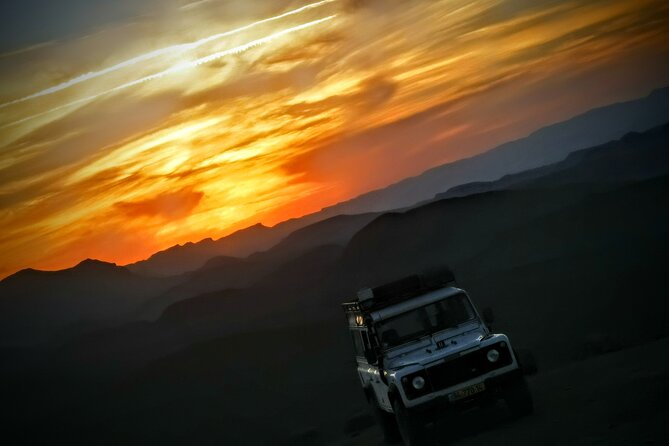
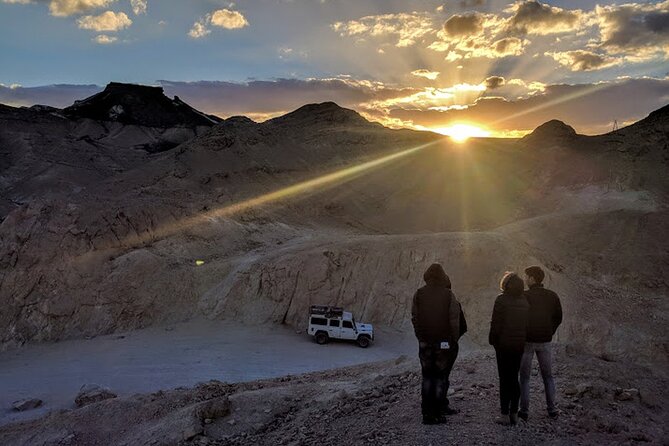
Next comes the viewpoint climb. You’ll move by 4×4 to a lookout point at the top of Mt. Gewanim. This stop runs about 30 minutes and also includes admission.
The big promise here is scale: from this height, you get a panoramic, 360-degree view of the crater and far beyond. It’s the kind of place where you can feel why photographers love timing. The tour is built for the golden hour, when the desert colors turn richer and shadows help shape the rock formations.
This stop also sets up the mental switch from “day exploring” to “night sky.” After you take your photos and enjoy the cool evening breeze, you’re ready to slow down again.
Small consideration: a viewpoint stop is short by design. If you’re the type who wants 45 minutes to linger with one perfect angle, you might wish it were longer. But for most people, 30 minutes is enough to soak it in without losing the night-sky schedule.
Stop 3: Campfire, tea and coffee, then stargazing with binoculars
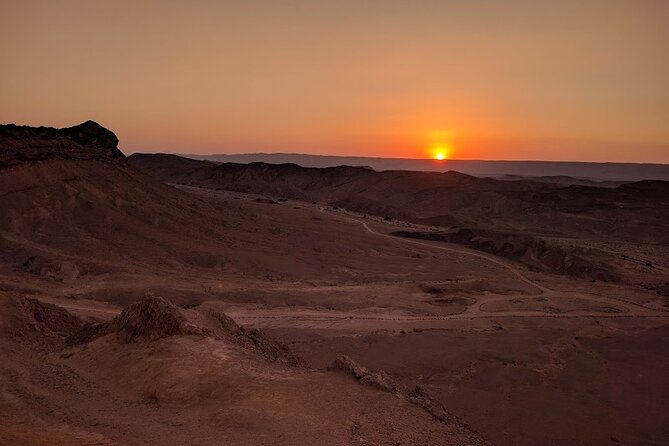
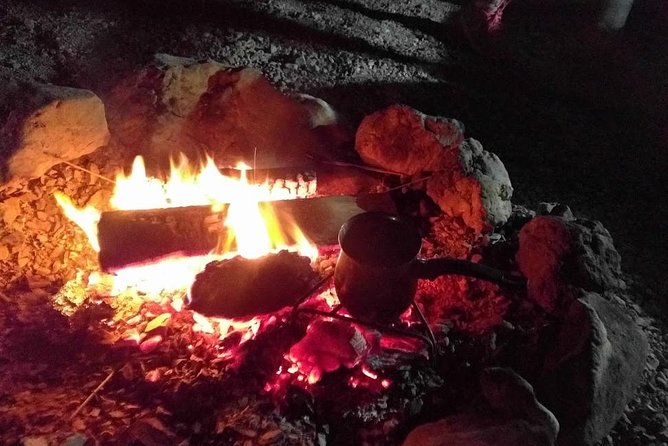
This is the heart of the experience. The final segment is about 2 hours. You’ll drive to a quieter spot, light a campfire, and settle in with fresh tea and coffee. The guide will help you adjust to the dark, which matters more than you’d think. Even a small amount of light changes your eyes and your ability to pick out faint stars.
Then comes the sky lesson. The tour is designed as telescope-free stargazing, using binoculars, a laser pointer, and simple tools to help you learn what you’re seeing. You’ll go through stars and planets, the Moon, constellations, and Zodiac signs.
What I like about this approach is that it doesn’t demand technical knowledge. If you’re not an astronomy person, you still get something tangible: names, patterns, and an easier way to make sense of what you’re seeing.
A fair caution: if you’re hoping for a serious telescope session with deep-sky viewing, this is not that. The experience is about understanding the sky with basic tools and guidance. It can still be magical, just in a simpler way.
The guide factor: Eyal’s style and why it matters in the dark
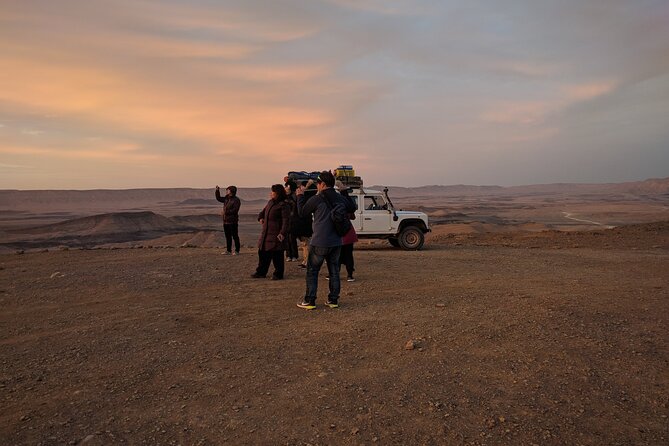
One name stands out in the tour’s recent feedback: Eyal. People highlight him as a strong guide who helps make the whole arc feel special, from crater views in daylight to sunset and then the night sky by the bonfire. The tour’s concept is strong on paper, but the execution is what you’ll feel most when you’re out there after dark.
Since you might be in a group of up to eight, guidance style matters. A good guide can keep the group moving at the right pace, handle the timing as twilight fades, and explain the sky in a way that helps you actually see what they’re pointing out.
The little extra that can happen on clear nights is the Moon. In one account, a strawberry moon was mentioned as part of the night atmosphere. You can’t count on the exact lunar moment, but it’s a good reminder that the sky has variety, and the tour is set up to let you enjoy it.
Getting the most out of a sunset crater + stars night
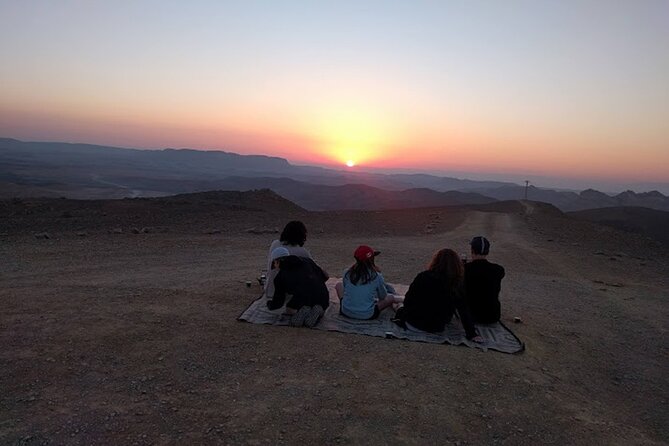
You’ll enjoy this tour more if you treat it like a planned evening shift, not just a photo stop.
Pack for cool desert night air
- Wear layers, and add something for warmth once you’re sitting by the fire and looking up.
- Closed-toe shoes are smart since you’ll step out during crater stops.
Plan your evening around the start
Meeting is late-day. If you try to squeeze dinner right before pickup, you’ll likely feel rushed. I recommend eating earlier, then letting the desert be the main event.
Bring your curiosity
The stargazing portion works best when you lean in. You’ll see the Moon, planets, constellations, and Zodiac signs with help from the guide, but you’ll get more out of it if you ask a question or two when something catches your eye.
Logistics, weather, and timing: the only real weak spot
This is one of those activities where the weather decides the mood, not just the schedule. The operator says the experience requires good weather, and the sky and conditions are part of the reason you can’t just treat it like a casual walk-up plan.
They also note that:
- For summer, the itinerary is scheduled and adapted to departure times.
- For autumn or winter, reservations are possible with limited guarantee depending on weather.
- A weather possibility can be known as late as three days before the tour, with a final update if it can go out or not.
So if you’re on a tight itinerary with zero flexibility, consider how you’d feel about a possible reschedule.
Who should book this tour (and who should look elsewhere)
This tour fits best if you want:
- A private group experience rather than a crowded bus ride
- Late-day crater exploring that transitions naturally into night
- Guided stargazing that’s friendly for beginners
- A bonfire moment with coffee or tea
It may be less ideal if:
- You need a highly predictable weather-proof schedule
- You’re expecting telescope-only astronomy
- You’re staying outside the Mitzpe Ramon area and don’t want to deal with pickup limits
Kids can join, but they must be accompanied by an adult. Also, most people can participate, though the off-road elements and evening timing mean it’s best for those comfortable being outside for several hours.
Should you book? My honest take
If you and your group want Ramon Crater in its best light—day, sunset, and then the sky—the tour delivers a full arc. The combination of off-road crater exploring, a high viewpoint at Mt. Gewanim, and a guided telescope-free stargazing lesson is a smart use of time. And the private format makes it feel less like an attraction and more like a guided evening in the desert.
The decision hinge is weather flexibility. If you can handle a possible date shift and you’re excited about learning the sky with binoculars and a laser pointer, book it. If you’re counting on a strict itinerary or you only want telescope-level astronomy, you may be happier with a different option.
If you do book, I’d treat it as a core evening plan and build the rest of your day around it. In the desert, timing is part of the product, and this one is timed on purpose.
FAQ
When do I meet for the sunset Ramon Crater jeep tour?
You meet in the Mitzpe Ramon area around 17:30 to 18:00 (seasonal timing is adapted, and the tour starts about an hour and a half before sunset).
Is this a private tour?
Yes. It’s a private tour, meaning only your group participates.
How long is the tour?
The duration is about 4 hours 30 minutes.
Do you use telescopes for stargazing?
No. The stargazing experience is telescope-free and uses binoculars, a laser pointer, and other simple tools.
What drinks are included at the campfire?
Coffee and/or tea are included, and they’re served while you relax by the bonfire.
Is alcohol included?
No. Alcoholic drinks are not included.
Is food included?
Food and drinks are not included unless specified. The tour includes coffee and/or tea, but it’s not listed as a full meal.
What happens if weather is poor?
The experience requires good weather. If it’s canceled due to poor weather, you’ll be offered a different date or a full refund.
What is the cancellation policy?
You can cancel up to 24 hours in advance for a full refund. If you cancel less than 24 hours before the start time, the amount paid is not refunded.
Can children join the tour?
Yes, but children must be accompanied by an adult.