
REVIEW · LONDON
Royal Observatory Greenwich & Prime Meridian Entry Ticket London
Book on Viator →Operated by National Maritime Museum · Bookable on Viator
Greenwich time is real time. This entry ticket gets you to the place where the world’s longitude story starts, with the famous Prime Meridian photo moment. I like that you can literally straddle east and west, right where Greenwich Mean Time is anchored.
What really makes this ticket work for your trip is the audio guide and the way it turns big ideas into something you can walk through. You’ll move through Flamsteed House, see the Octagon Room designed by Sir Christopher Wren, and meet the era of clocks and public time signals. One consideration: the site is up a steep hill with stairs and not everything is fully accessible, so plan carefully if mobility is an issue.
In This Review
- Key things that make this ticket worth your time
- Entering the Prime Meridian’s actual address in Greenwich
- Getting there and handling the steep hill (views are the payoff)
- A practical arrival tip
- Meridian Courtyard: the moment you stand on both hemispheres
- Flamsteed House: walking in the footsteps of Astronomers Royal
- What you’ll likely enjoy most in Flamsteed House
- Octagon Room and Sir Christopher Wren’s design
- Harrison’s clocks, the Shepherd Gate Clock, and the public face of GMT
- The Great Equatorial Telescope in the onion dome
- Pairing your visit with free Maritime Greenwich stops
- Don’t forget Cutty Sark
- How long the visit really takes (and how to avoid rushing)
- Ticket value: what you pay and what you get for it
- One small caution about mobile tickets
- Who should book this Royal Observatory Greenwich ticket?
- Who might find it harder
- Should you book this Prime Meridian entry ticket?
- FAQ
- How long does the Royal Observatory Greenwich visit take?
- Is the audio guide included?
- Do I need a printed ticket?
- Where do I stand to take photos for the Prime Meridian?
- Are the National Maritime Museum and Queen’s House included in the ticket price?
- Is Cutty Sark part of the experience?
- Are children allowed?
- Is the attraction easy to reach using public transportation?
- Do you offer free cancellation?
Key things that make this ticket worth your time
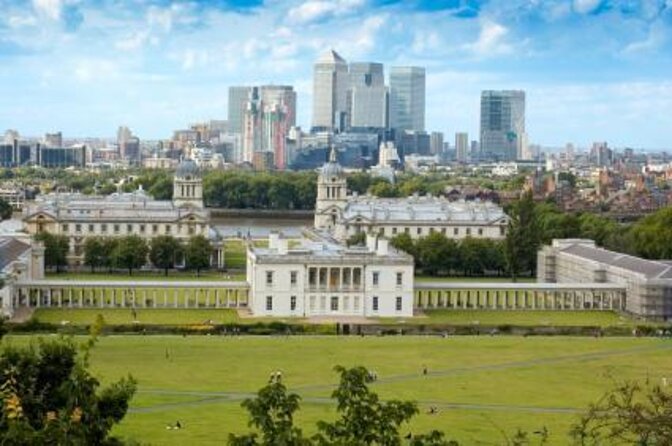
- Prime Meridian photo ops: stand with one foot in the east and one in the west
- Audio guide learning track: you can pick up a complementary guide with multiple language options
- Clock-and-time highlights: Harrison’s clocks and the Time Ball signal the history behind modern timekeeping
- Wren architecture inside: the Octagon Room is one of the best-preserved Wren interiors in London
- Big-scope astronomy: the Great Equatorial Telescope sits in the iconic onion dome
- Maritime Greenwich add-ons nearby: National Maritime Museum and Queen’s House are free and walkable
Entering the Prime Meridian’s actual address in Greenwich

The Royal Observatory Greenwich experience is easy to misunderstand before you arrive. It’s not just a stamp in your passport for London; it’s a physical marker that helped the world agree on time and position. When you’re at the Meridian Courtyard, it finally clicks why longitude and time mattered so much for navigation.
This ticket is also a smart move for scheduling. It’s a popular stop, and it’s commonly booked about 35 days in advance, so choosing a slot ahead of time saves you the stress of hunting for openings.
And because the visit is designed around your pace, you control how fast you move. Think of it as a guided-feeling walk, powered by the downloadable audio guide and the self-led route through the buildings and exhibits.
You can also read our reviews of more tours and experiences in London.


Getting there and handling the steep hill (views are the payoff)
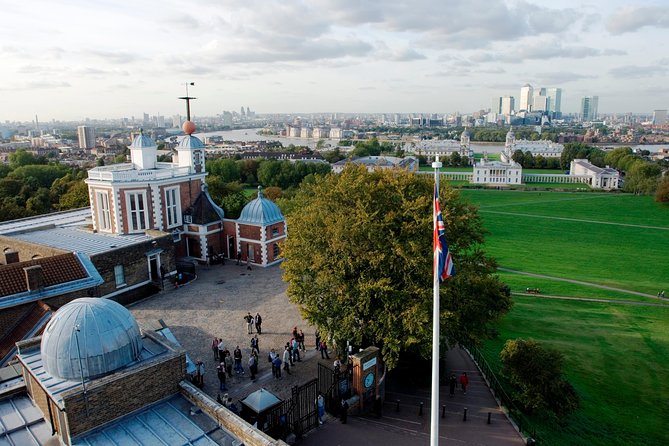
First, set expectations: you’re going uphill. The observatory sits on a hill in Greenwich Royal Park, and that climb is part of the experience. The good news is the views are dramatic—London’s skyline, the City of London, and the River Thames show up as you get closer.
If you want a smoother day, treat this like a “wear good shoes” kind of outing, not a quick stroll. Rain can make the outdoor walking less pleasant, too, because you’ll be outside as you work your way to the key rooms and viewpoints.
A practical arrival tip
Because the area can get busy, I’d plan to do your most important photos early after you arrive. Once crowds build, it’s harder to get a clear shot astride the line.
Meridian Courtyard: the moment you stand on both hemispheres
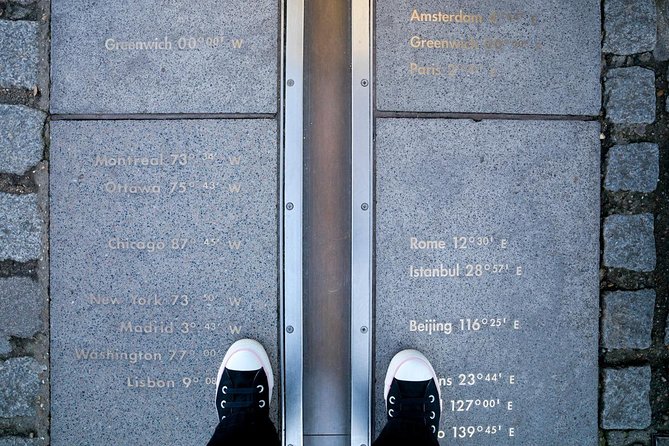
Your visit starts where the story gets literal: the Meridian Courtyard. This is where you stand astride the Prime Meridian line—one foot in the east, the other in the west—marking the home of Greenwich Mean Time (GMT).
This is a rare kind of tourism. Most attractions show you something far away through glass. Here, you’re on the coordinate system itself. The feeling isn’t mystical; it’s more like stepping onto a page from the history books, with your shoes right on the exact line.
If you’re with family or friends, this is the stop that works across ages. Even people who don’t care about astronomy usually care about a human-sized “spot the planet” moment.
Flamsteed House: walking in the footsteps of Astronomers Royal
Next, you’ll move into the heart of the observatory’s working past. Flamsteed House anchors the route, and the exhibits are arranged to help you follow the science and the people who did it.
The standout for me is how the place connects names to the work they did. You’ll see displays tied to major figures associated with the observatory and the wider story of measurement and discovery, including Harrison, Newton, Halley, Bradley, Maunder, Airy, and Einstein.
What you’ll likely enjoy most in Flamsteed House
- The way timekeeping and space science show up together
- The evolution from early public signals to the systems that help navigation today
- The narrative links between scientists and the technology they influenced
It’s also a good segment for questions. If you catch staff talks or helpful explanations while you’re moving through, you’ll get more out of the room displays than by reading labels alone.
Octagon Room and Sir Christopher Wren’s design

One of the architectural highlights is the Octagon Room, designed by Sir Christopher Wren. The room matters because it’s not just pretty; it’s tied to the best-preserved Wren interiors in London.
Inside, the exhibit framing helps you slow down. Instead of racing between “cool things,” you can stand, look up, and connect the scientific tools to the building they were housed in. It’s the kind of detail you’ll remember later when you think about how old science spaces were built for long, careful work.
Harrison’s clocks, the Shepherd Gate Clock, and the public face of GMT
The observatory’s time story gets real when you see how public time signals used to work.
You’ll encounter Harrison’s clocks, the inventions that changed the world by making more precise time measurement possible. This is the part that turns astronomy and navigation from abstract concepts into something practical: accurate time meant better position at sea.
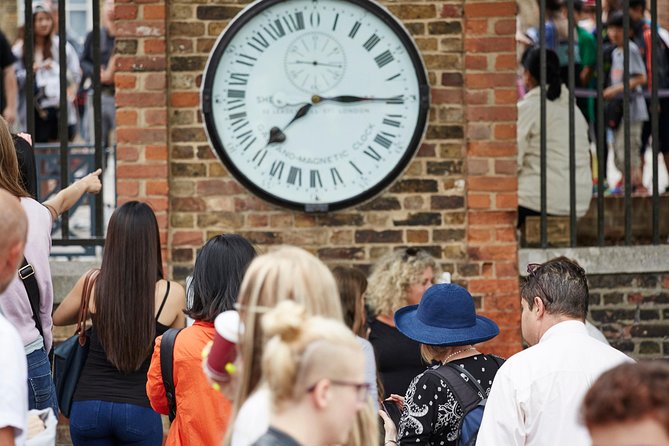
Don’t miss the Shepherd Gate Clock, mounted outside. It’s described as the first clock to show Greenwich Mean Time to the public. That detail is powerful because it reminds you that today’s time isn’t just for scientists—it had to be communicated to ordinary people.
And if you want one “spot it immediately” landmark, climb your eyes to the top of Flamsteed House. The red Time Ball was first used in 1833 and still operates. It’s one of the world’s earliest public time signals, and it’s easy to see why people used to rely on it.
The Great Equatorial Telescope in the onion dome
If you have any interest in astronomy, the big telescope is where your brain can finally go from history mode to curiosity mode.
The Great Equatorial Telescope sits inside the huge iconic onion dome. It’s the telescope that gave astronomers new views of the universe over a century ago, and the exhibits around it help you understand what that actually meant for knowledge at the time.
This stop balances out the timekeeping theme. Up to this point, you’re thinking longitude, GMT, clocks, and public signals. Here, you’re looking at the sky-facing counterpart—how the same obsession with measurement also supports what people learned about space.
Pairing your visit with free Maritime Greenwich stops

Here’s where you can stretch value without paying for extra tickets.
The Royal Observatory is located within the UNESCO World Heritage Site of Maritime Greenwich, and two major museums are within a short walk:
- National Maritime Museum (free to visit)
- Queen’s House (free to visit)
That means you can build a full half-day or more around a theme: time, ships, and how measurement helped the movement of people and goods.
Don’t forget Cutty Sark
If you’re looking for another high-impact addition, Cutty Sark, the world’s sole-surviving tea clipper, is now an award-winning museum and visitor experience. It’s listed as a must-see when visiting Greenwich, and it fits perfectly with the maritime context.
How long the visit really takes (and how to avoid rushing)
The ticket is listed at around 2 hours. That’s a solid target, especially if you:
1) grab the audio guide,
2) do the Meridian Courtyard photos,
3) take time with clocks and the Octagon Room,
4) stop at the telescope.
But if you’re the type who likes to read every label, you might end up at the high end of that time—or slightly beyond. A good strategy is to decide your priorities before you enter. For example:
- If your #1 goal is Prime Meridian photos and GMT, you can keep it tight.
- If your goal is Harrison’s clocks and Wren architecture, plan a slower pace through Flamsteed House and the key rooms.
Also, note that crowds can form quickly. Getting inside earlier in your day often makes the whole experience feel calmer.
Ticket value: what you pay and what you get for it
At $33.90 per person, you’re paying for access to the observatory’s exhibits plus the complementary audio guide experience. For central London, that’s not a bargain like a free museum, but it’s not overpriced either—because this is a very specific place with very specific meaning.
What makes it feel like good value is the mix:
- A one-of-a-kind physical site (Prime Meridian line)
- Two layers of learning (audio guide + exhibit sequence)
- Multiple “stand here and look” moments (courtyard line, telescope dome, views from the hill)
If you’re visiting Greenwich anyway, this ticket is even stronger. The free National Maritime Museum and Queen’s House nearby mean you can add more culture without adding more admission costs.
One small caution about mobile tickets
You’ll have a mobile ticket, which is convenient. Still, have a backup mindset: if your barcode or app access fails to scan smoothly, you may need to sort it at the venue. Bring your confirmation details (email screenshot or booking reference) so you’re not stuck at the entrance.
Who should book this Royal Observatory Greenwich ticket?
This ticket fits best if you like one (or more) of these:
- Science history and the story behind modern time
- Geography and longitude
- Architecture details (yes, even if you only notice it sometimes)
- Families who want a “wow” photo plus a real learning path
It’s also a strong couples choice. You get shared photo time at the Meridian, then quieter indoor moments with clocks and telescopes.
Who might find it harder
If mobility is a concern, the hill and stairs matter. Some areas aren’t fully accessible, and there are limited lift options. If you need step-free routes, it’s worth checking directly with the attraction before you commit.
Should you book this Prime Meridian entry ticket?
I’d book it if you want a London stop with built-in meaning, not just a building with views. The Prime Meridian photo moment is genuinely special, and the combination of clocks, public time signals like the Time Ball, and the Great Equatorial Telescope gives you a balanced mix of measurement on Earth and measurement in space.
I’d also book it if you’re the type who enjoys learning while walking—because the audio guide route makes the information feel connected rather than random.
Only skip or reconsider if stairs and steep uphill routes are a dealbreaker for your group, or if you want a mostly indoor, low-walking experience. In that case, Greenwich has other options that may feel easier.
If you’re a planner, make your day a Greenwich “time and sea” loop: Prime Meridian first, then use those nearby free museums to extend the story without extending the costs too much.
FAQ
How long does the Royal Observatory Greenwich visit take?
It’s listed at about 2 hours (approx.), depending on how much time you spend with the audio guide and exhibits.
Is the audio guide included?
Yes. You can download the free audio guide in multiple languages, and you can also pick up a complementary audio guide on site.
Do I need a printed ticket?
No. The ticket is provided as a mobile ticket, and confirmation is received at booking.
Where do I stand to take photos for the Prime Meridian?
You’ll stand in the Meridian Courtyard astride the Prime Meridian line, where one foot is in the east and the other in the west.
Are the National Maritime Museum and Queen’s House included in the ticket price?
They are not included in the ticket, but both are free to visit and are within a short walking distance from the Observatory.
Is Cutty Sark part of the experience?
Cutty Sark is near the Observatory and is described as a must-see, but it’s not listed as included with this specific ticket.
Are children allowed?
Children under 4 years enter for free, and children must be accompanied by an adult.
Is the attraction easy to reach using public transportation?
It’s noted as near public transportation, so it should be reasonably straightforward to get to.
Do you offer free cancellation?
Yes. Free cancellation is available if you cancel up to 24 hours before the experience’s start time for a full refund.